Table of Contents
Digital marketing automation tools in 2026: the digital realm has become essential for companies that want to grow effectively, save time, and optimize their marketing activities. Digital marketing automation tools in 2026 will help businesses streamline repetitive tasks and create more efficient marketing campaigns. A great digital marketing automation tool allows business owners to automate processes such as sending emails, lead nurturing, customer segmentation, social media scheduling, customer follow-ups, and performance reporting. Modern Digital Marketing Automation Tools also combine artificial intelligence, workflow automation, CRM integration, analytics, and personalization to deliver better marketing results.
Whether you run a startup, small business, marketing agency, e-commerce store, or large enterprise, choosing the right digital marketing automation tool can significantly improve your marketing workflow. Instead of spending hours on repetitive manual tasks, marketers can use automation to focus more on strategy, creativity, content, and meaningful customer communication. These tools can also help businesses maintain consistent engagement across multiple digital channels.
Digital Marketing Automation Tools in 2026 One of the biggest advantages of digital marketing automation tools is their ability to deliver the right message to the right audience at the right time. Automated workflows can respond to customer actions, such as website visits, form submissions, email interactions, purchases, or abandoned carts. This allows businesses to create personalized customer journeys while reducing the amount of manual work required.
By using the right digital marketing automation tool, businesses can improve lead generation, nurture prospects, increase customer engagement, strengthen retention, and ultimately convert more leads into paying customers. As artificial intelligence continues to evolve, digital marketing automation tools in 2026 are becoming smarter, more predictive, and more valuable for businesses looking to compete in a rapidly changing digital marketing environment.
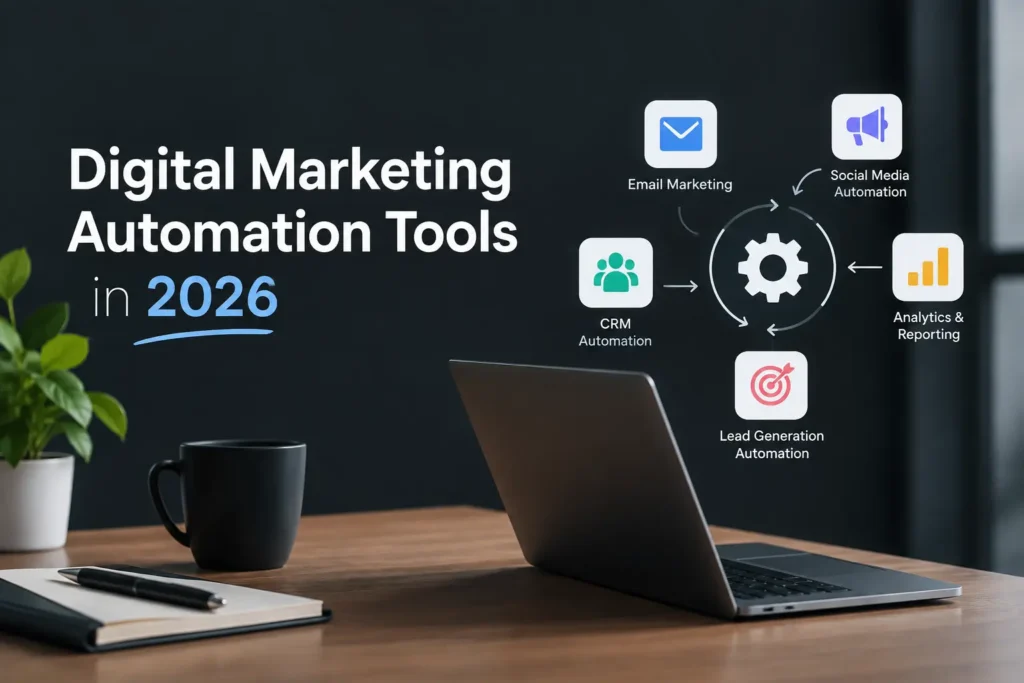
What Is a Digital Marketing Automation Tool?
Benefits
Digital Marketing Automation Tools in 2026 Saves time through automated workflows. The concept of digital marketing automation “tools” refers to the process of digital marketing automating marketing processes through the application of software, technologies, and artificial intelligence solutions. Instead of completing every task manually, companies can automate processes by creating workflows.
Digital marketing automation tools in 2026 can be used to organize and complete many activities, including email campaigns, lead nurturing, customer segmentation, lead scoring, scheduling social media posts, ad workflows, personalizing content, customer follow-up, and marketing analytics. This approach will allow marketers to save time while communicating consistently with prospects and clients.
For instance, when a person signs up for an ebook on your website, an automation tool can automatically add this user to your database, score the lead, send a welcoming email, and include him/her in a nurturing campaign. If the person opens emails, visits necessary pages, or asks for a product demo, the tool can change the lead score and inform the sales team about it.
- – Improves personalization
- – Increases conversions and ROI
- – Better lead nurturing
- – Stronger analytics and reporting
- – Consistent customer experiences
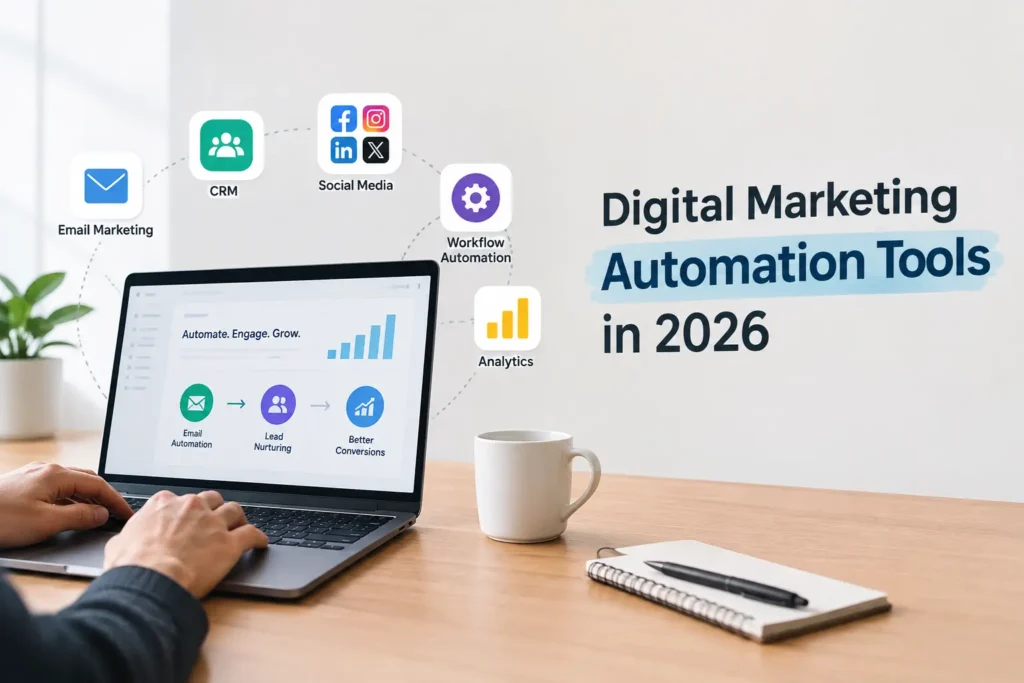
Popular Digital Marketing Automation Tools in 2026
HubSpot: Suitable for marketing automation with AI-powered workflows, integrations, and campaign management.
ActiveCampaign: Suitable as a digital marketing automation tool with AI-powered workflows, integrations, and campaign management.
Mailchimp is a tool that’s good for marketing automation. It uses intelligence to help with workflows. It has integrations and helps with managing campaigns. Mailchimp is a good digital marketing automation tool. It uses intelligence to help with workflows. It has integrations and helps with managing campaigns.
- Brevo: Suitable for marketing automation with AI-powered workflows, integrations, and campaign management.
- Klaviyo: Suitable for marketing automation with AI-powered workflows, integrations, and campaign management.
- Omnisend: Suitable for marketing automation with AI-powered workflows, integrations, and campaign management.
- Zapier: Suitable for marketing automation with AI-powered workflows, integrations, and campaign management.
- Make: Suitable for marketing automation with AI-powered workflows, integrations, and campaign management.
- Salesforce Marketing Cloud: Suitable for marketing automation with AI-powered workflows, integrations, and campaign management.
- Marketo: Suitable for marketing automation with AI-powered workflows, integrations, and campaign management.
- Zoho Marketing Automation: Suitable for marketing automation with AI-powered workflows, integrations, and campaign management.
- Constant Contact: Suitable for marketing automation with AI-powered workflows, integrations, and campaign management.
- Drip: Suitable for marketing automation with AI-powered workflows, integrations, and campaign management.
- Kit (ConvertKit): Suitable for marketing automation with AI-powered workflows, integrations, and campaign management.
- GetResponse: Suitable for marketing automation with AI-powered workflows, integrations, and campaign management.
- Keap: Suitable for marketing automation with AI-powered workflows, integrations, and campaign management.
- Pardot: Suitable for marketing automation with AI-powered workflows, integrations, and campaign management.
- SendPulse: Suitable for marketing automation with AI-powered workflows, integrations, and campaign management.
- Customer.io: Suitable for marketing automation with AI-powered workflows, integrations, and campaign management.
- Ortto: Suitable for marketing automation with AI-powered workflows, integrations, and campaign management.
Marketing Automation in Small Businesses
Automating yourself does not require lots of sophisticated tools when talking about small businesses.
The presence of only a simple automation solution is enough:
- One CRM system
- One e-mail automation tool
- One social media scheduler
- One analytics device
- One integration instrument
- One AI as a content assistant
Comparison Snapshot
| Tool | Best For | AI | Free Plan | Ease |
| HubSpot | All-in-one | Yes. | Yes. | Easy |
| Klaviyo | Ecommerce | Yes. | Yes. | Medium |
| Zapier | Automation | Yes. | Yes. | Easy |
| Marketo | Enterprise | Yes. | No | Advanced |
How to Choose
Consider your budget, business size, integrations, reporting needs, AI capabilities, and scalability. Digital Marketing Automation Tools in 2026 Small businesses often benefit from Brevo or Mailchimp, while enterprises may prefer HubSpot, Marketo, or Salesforce.
Common Errors to Avoid When Using Digital Marketing Automation Tools in 2026
Digital marketing automation tools in 2026 can save time, boost productivity, and make customer experiences more consistent. Automation alone does not guarantee better marketing results. If campaigns are poorly planned or too automated, businesses may lose engagement and harm customer trust. Below are mistakes marketers should avoid in 2026.
1. Over-Automating Your Marketing
Automation should support digital marketing automation tools in 2026 strategy, not fully replace interaction. Automating every customer interaction can make messages feel robotic, repetitive, or impersonal. Use automation for tasks such as email follow‑ups, lead scoring, reporting, and scheduling while keeping important customer conversations personalized.
2. Poor Audience Segmentation
Sending the automated message to the entire audience is one of the biggest mistakes businesses make. Customers have interests, needs, and positions in the buying journey. Use segmentation based on demographics, behavior, purchase history, engagement, or lead stage to deliver relevant content.
3. Ignoring Analytics and Performance Data
Launching an automated campaign is not enough. Marketers need to monitor metrics such as open rates, click‑through rates, conversion rates, engagement, customer acquisition cost, and return on investment. Analytics can reveal which campaigns are performing well and where improvements are needed.
4. Failing to Test Campaigns
Well‑designed automated workflows can contain errors. Before launching a campaign, test emails, links, forms, triggers, personalization fields, and follow‑up sequences. A/B testing subject lines, content calls to action, and sending times can also help improve campaign performance.
5. Using Automation Without a Clear Strategy
Choosing a digital marketing automation tool in 2026 without defining goals can lead to wasted time and money. Before implementing marketing automation tools, identify what you want to achieve—such as generating leads, increasing conversions, improving customer retention, or reducing repetitive work. Your digital marketing automation tools’ workflows should support these business objectives.
6. Neglecting Personalization
Customers are more likely to respond when content reflects their interests and behavior. Use customer data to personalize emails, recommendations, offers, and follow‑up messages without making interactions feel intrusive.
7. Creating Workflows
A complicated workflow may look advanced, but it can become difficult to manage and troubleshoot. Start with simple digital marketing automation tool workflows. Gradually add complexity when there is a clear business benefit. Regularly review digital marketing automation tools in 2026 workflows and remove steps.
8. Forgetting the Human Element
AI marketing tools and digital marketing automation tools in 2026 can handle repetitive tasks, but human creativity, judgment, and empathy remain important. Give customers opportunities to connect with a person when they have complex questions or need support.
9. Not Keeping Customer Data Clean
Marketing automation depends heavily on customer data. Duplicate contacts, information, incorrect email addresses, and incomplete customer profiles can reduce campaign effectiveness. Regularly. Update your database to maintain accurate segmentation and personalization.
10. Failing to Review Automated Campaigns
Once an automation workflow is activated, do not simply leave it running indefinitely. Customer behavior, market conditions, products, and business goals can change over time. Review digital marketing automation tools in 2026 campaigns and update the messaging triggers, offers, and workflows when necessary.
The key takeaway: Powerful digital marketing automation tools in 2026 work best when technology and strategy are combined. Avoiding these mistakes allows businesses to automate repetitive marketing activities while maintaining personalization, accuracy, and meaningful customer relationships.
Future Trends
AI agents, predictive marketing, omnichannel automation, no-code workflows, first-party data, and privacy-first personalization will shape marketing automation in 2026.
Conclusion
Choosing the Best Digital Marketing Automation Tool
The choice of the best digital marketing automation tool will depend on the marketing objectives, budget, size of the company, and needs for marketing. It is recommended to evaluate whether you need features such as email marketing automation, lead generation, customer segmentation, CRM integration, social media scheduling, analysis, and other functions before choosing a platform to utilize.
When choosing a digital marketing automation tool, it is crucial to pay attention to the usability and scalability of the solution, as well as its price. Consider a pricing model that suits you, availability of customer support, automation possibilities, and compatibility of the solution with existing software used by the company. The use of the right digital marketing automation tool will allow you to get rid of manual actions, nurture your leads, personalize interactions with the customers, and make your team more productive by saving time.